


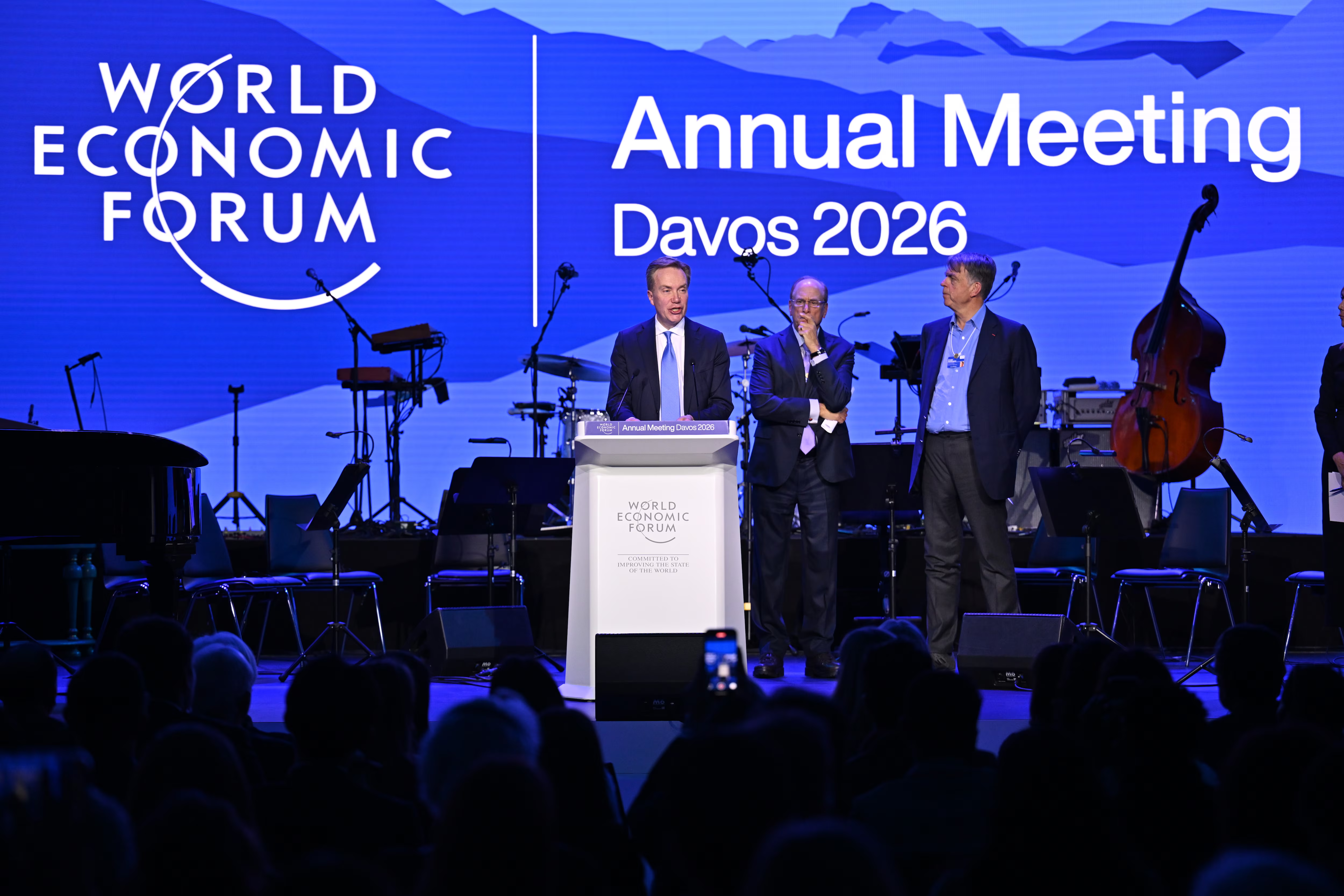
For more than fifty years, the World Economic Forum has defined what a global business summit looks like. Five days in Davos every January, a curated guest list of heads of state, CEOs, and policy figures, a public agenda of panels on the great issues of the moment, and a private agenda of bilateral meetings that determine much of what actually gets decided in the room. The format works. It has shaped global discourse, established personal relationships at the highest levels, and given the international policy community a single point on the calendar where the most important conversations happen in the same place.
OBS Summit is not trying to replicate that format. It is trying to do something different — and the differences are deliberate.
This is not a critique of Davos. The World Economic Forum has earned its position, and OBS Summit takes its existence as the baseline against which a new kind of business gathering can usefully be defined. But the structure of OBS Summit reflects a clear thesis: that the next generation of global business needs a forum built around a different set of priorities than the one Davos was designed to serve. Here are five of them.
1. Length: 100 days, not 5
The most fundamental structural difference is duration. The World Economic Forum's annual meeting compresses its entire programme into a single intense week. OBS Summit runs for 100 days — from 15 October 2026 through 22 January 2027 — across multiple cities and continents.
The implication is not that OBS Summit is "more" of the same thing. It is that the format itself enables a different type of engagement. A five-day window forces every interaction into the same moment, and most participants leave Davos with a list of follow-ups that take the next eleven months to actually execute. A 100-day arc makes the follow-up part of the summit itself. Conversations that begin in Dubai in October can produce signed agreements in London in November and pilots launched in Singapore in December — all within the same convening period.
For businesses whose value comes from execution rather than positioning, the difference matters. The summit does not end the moment the closing dinner finishes. It runs long enough that the deals it generates are visibly part of its outcome.
2. Geography: seven cities, not one mountain town
Davos is geographically fixed by design. The mountain setting is part of the forum's identity, and the friction of travel is — intentionally — part of what defines who gets there. OBS Summit takes the opposite approach, deliberately distributing its programme across seven major cities: Dubai, London, New York, Riyadh, Mumbai, Singapore, and Nairobi.
The seven-city footprint is not a logistical convenience. It is a thesis about where the centre of gravity of global business now sits. Each host city represents a region whose growth trajectory, capital flows, and policy direction will materially shape the global economy over the next decade. Holding sessions in those cities — rather than asking the world to come to a single venue — recognises that the conversations that matter happen in the markets that matter, with the people who actually live and work in them.
It also lowers the participation threshold. A business leader in Lagos, Mumbai, or São Paulo no longer needs to make the case internally for a five-day round trip to a Swiss village to access the network. The network comes to a city in their region, and the regional conversation becomes part of the global one. The summit's Asia Pacific programme is structured around exactly this principle.
3. Audience: builders and operators, not just heads of state
The World Economic Forum's programme is, structurally, organised around heads of state, ministers, and the CEOs of the world's largest corporations. The conversations are framed in the language of multilateral policy and strategic alignment. That framing produces real value, but it also produces a guest list that skews heavily toward the people who set the rules rather than the people who build under them.
OBS Summit is built around a different mix. Heads of state and major-company CEOs are part of the programme, but so are the founders, operators, sovereign-wealth investors, regional family offices, mid-market business leaders, and category-defining entrepreneurs whose decisions actually move capital and create economic activity. The intent is not to dilute the seniority of the room but to broaden the surface area of the conversation — to put the people writing the deals in the same setting as the people setting the policies that shape them.
For a CEO of a $2 billion regional business in the Gulf or South-East Asia, OBS Summit is structured as a primary destination, not a satellite event running in parallel.
4. Outcomes: transactions, not communiqués
The deliverables of the World Economic Forum are predominantly intellectual: published reports, public statements, multistakeholder initiatives, and the public framing of priorities for the coming year. Those outputs matter. They shape how policy is debated, how risks are perceived, and how international institutions allocate attention. But they are not, by design, deal-oriented.
OBS Summit is structured around transactional outcomes. The programme is built to produce signed deals, capital allocations, joint ventures, market entries, supply contracts, and partnership agreements within the 100-day window. The agenda is engineered to make those outcomes the natural product of participation, not an incidental side effect. Sessions are organised around verticals where decisions can be made, the deal-room infrastructure is built into the programme, and the success metrics for the summit are denominated in transaction volume — not headlines.
This is the most concrete difference of the five. Davos measures itself in conversations and statements. OBS Summit measures itself in deals.
5. Access: open by default, curated where it matters
Davos is famously closed. Attendance is by invitation, the most consequential rooms within the conference are gated by additional layers of access, and the cost structure ensures that only the largest organisations can participate at the highest tier. The exclusivity is, again, part of the design — it is what allows the off-the-record conversations to happen at the level they do.
OBS Summit operates a hybrid model. The most senior closed-door sessions remain genuinely closed and curated. But significant portions of the programme — the public sessions, the regional events, the digital broadcast layer, the marketplace and exhibition components, and the OBS platform itself — are open to a much wider population of business participants. A founder in their first round of funding, a manufacturer in their first international expansion, a fund manager raising a debut vehicle, all have a path into the OBS Summit experience that does not require institutional sponsorship or a six-figure participation fee.
The result is a summit whose top-tier rooms are still as private as they need to be, but whose ambient business environment is dramatically more accessible than the Davos model permits. For a global summit positioning itself as a hub for the next generation of business leadership, that openness is not a compromise. It is the point.
Two formats, different jobs
The World Economic Forum was built for an era in which global policy and global business were a relatively small, geographically concentrated, and largely Western conversation. It served — and continues to serve — that era's needs exceptionally well.
OBS Summit is built for the era that has emerged since: a multipolar, multi-regional, transaction-heavy, founder-and-operator-driven business landscape in which the centre of gravity has shifted toward the Gulf, Asia, and Africa, and in which the most consequential conversations are no longer confined to a single week in a single Alpine town.
The two formats are not in opposition. They are doing different jobs for different versions of the global economy. But for businesses, investors, and decision-makers whose operating reality is the second one — multi-regional, deal-oriented, and increasingly defined by markets outside the historical Western core — OBS Summit is being built with their priorities in mind.
OBS Summit runs from 15 October 2026 through 22 January 2027 across Dubai, London, New York, Riyadh, Mumbai, Singapore, and Nairobi. Registration is open now.