



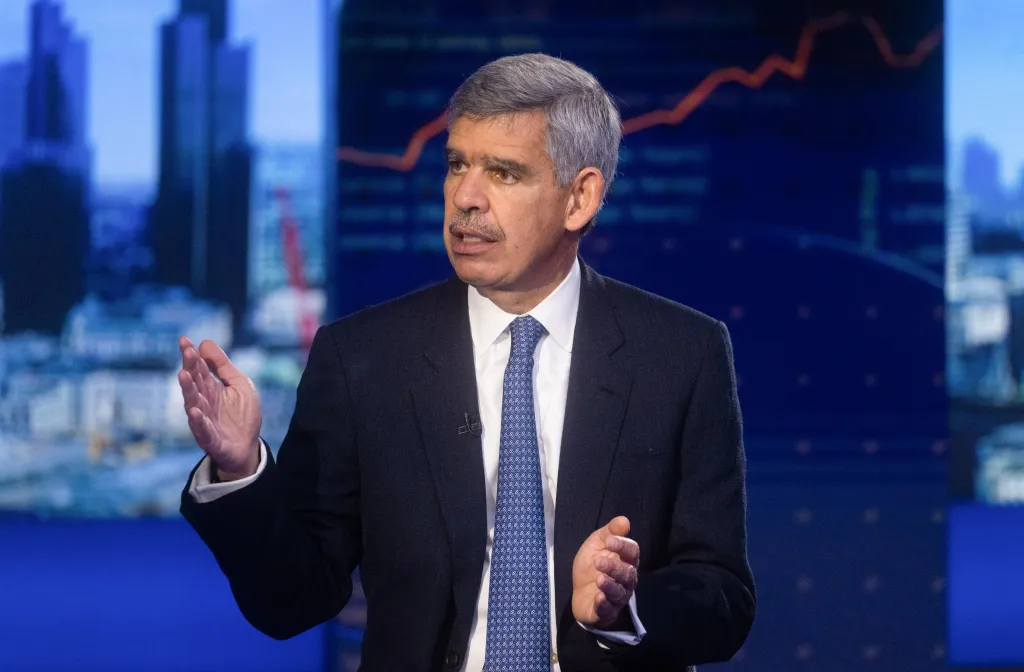
It is rare for a respected macro economist to put a number on a deadline. It is rarer still for that number to be measured in weeks rather than quarters. When Mohamed El-Erian, the former chief executive of Pimco and one of the most cited voices on global macro risk, said last week that the world has "four to eight weeks" to see the Strait of Hormuz reopened before the global economy moves from slowdown to recession, it should have been the headline of the day. In a market environment increasingly numb to geopolitical noise, his warning was specific, time-bound, and grounded in supply-chain mathematics that are not difficult to verify.
The crisis has now extended into its third month. Wall Street's initial assumption — that the standoff would resolve quickly through some combination of pressure, diplomacy, and market self-correction — has not aged well. Iran continues to threaten passing vessels. Insurance markets for tankers in the region have functionally seized. And the volume of crude and refined product that historically transits the strait — roughly 20% of global oil consumption — is moving through it at a fraction of the usual rate, with the difference being absorbed by drawdowns of inventories that were never designed to bridge a multi-month interruption.
El-Erian's point is not that the world has run out of oil. It is that the buffer between disruption and dislocation is thinner than the financial press has acknowledged.
The math behind eight weeks
Several data points cited in recent coverage make the timeline concrete.
Europe. Aviation fuel reserves across the bloc are estimated at roughly six weeks of consumption. Aviation fuel is one of the more difficult fractions to substitute on short notice — refining slates cannot pivot instantaneously, and alternative supply lanes from the US Gulf and West Africa are operating at maximum throughput already. Six weeks is not a comfortable buffer. It is the timeline at which carriers begin route consolidation, fares spike, and the secondary effects on tourism, business travel, and freight begin to show up in macro data.
Japan and broader Asia. Reports of panic buying — fuel, staple goods, items associated with COVID-era hoarding behaviour — are emerging in Tokyo, Osaka, and several other Asian metros. This is not the cause of supply pressure but a symptom of it. When consumers begin to behave as if shortages are imminent, the behaviour itself accelerates the shortages. Just-in-time inventory systems do not absorb that kind of demand shock gracefully.
The United States. Despite being a net energy exporter since 2019, the US still imported 17% of its domestic energy supply last year. The dependence on cross-border flows for specific grades of crude, refined products, and natural gas is structural. American consumers will feel the price effect even where they do not feel the volume effect — and price effect, in an economy where consumer sentiment is already fragile, has consequences that compound.
Eight weeks, in this context, is not a soft estimate. It is the point at which inventory exhaustion in the most exposed regions translates into real economic activity contraction — the kind that shows up in jobs data, retail sales, and capital expenditure plans within a single quarter.
Mark Zandi's parallel warning
Mohamed El-Erian is not alone. Mark Zandi, chief economist at Moody's, characterised current US growth as "fragile" and "not sufficient to support any meaningful job growth." His specific concern is that whatever positive momentum the US economy retains — from prior fiscal stimulus, from corporate buybacks, from the AI-driven capex cycle — is being progressively cancelled out by the second-order effects of the Middle East situation. Higher input costs, weaker consumer confidence, deferred capital projects, and a labour market in which unemployment is "steadily drifting higher" rather than reaccelerating downward.
The picture Zandi describes is not yet a recession. It is a US economy in which the cushion between expansion and contraction has been worn thin enough that any additional shock — and the energy shock is the most visible one currently on the table — pushes the math from positive to negative.
Why the markets have been slow to reprice
One of the most striking features of the current moment is the relative calm in equity markets. The S&P 500 has retraced only modestly from its all-time highs. Volatility, while elevated, has not spiked to the levels that would typically accompany an existential threat to a fifth of global oil supply. Credit spreads have widened, but well within historically normal ranges.
There are several explanations, none of them particularly reassuring:
Optionality bias. Markets have been conditioned, through a decade of central bank intervention and rapid resolution of prior crises, to assume that any acute shock will be resolved before it becomes structural. The base case priced into current valuations is that the strait reopens, oil reverts toward $80–90, and the cycle continues. That base case is increasingly difficult to defend on a probability-weighted basis, but it remains the consensus.
Sectoral concentration. The headline US indices are dominated by a handful of mega-cap technology companies whose earnings are not particularly sensitive to oil price in the short term. The damage from the energy shock is concentrated in industrials, consumer discretionary, transportation, and emerging market equities — sectors that are smaller in index weighting and easier for headline-watching investors to overlook.
The inflation problem. Even where investors recognise the risk, the policy response is constrained. The Federal Reserve cannot cut rates aggressively into a supply-shock inflation episode without exacerbating the inflationary leg of the problem. The ECB faces the same constraint. The traditional "Fed put" — the assumption that any meaningful market dislocation would be met with rapid liquidity easing — is structurally weakened by the inflation backdrop.
What a recession scenario actually looks like
If El-Erian's eight-week window expires without resolution, the scenario most analysts are stress-testing against has the following contours:
Brent crude moving into the $130–160 range and remaining there for at least two quarters. Aviation fuel and diesel reaching effective rationing in parts of Europe. A coordinated demand destruction response from major importers — economically painful, politically destabilising, and transmitted into consumer prices across virtually every category.
Global GDP growth revised downward by 1.0–1.5 percentage points relative to current consensus, pushing the world economy from sub-3% growth into territory that meets most working definitions of global recession.
A re-rating of equity markets — particularly the parts of the index priced for perfection — that could see drawdowns of 20–35% peak to trough in the most exposed names.
An emerging-market crisis dimension that has not yet entered headline discussion: countries running structural energy import bills (India, Turkey, much of South-East Asia, parts of Latin America) facing acute current-account pressure and currency stress within weeks of a sustained price spike.
This is not a Lehman scenario. It is, however, a recession that arrives faster, is harder to fight with conventional policy tools, and lasts longer than the 2020 contraction did — because the supply-side trigger does not respond to interest rate cuts.
What investors and businesses should be doing now
The OBS Global advisory framework on the current situation rests on three points.
Reduce exposure to assets priced for the optimistic resolution. The most vulnerable positions are those that simultaneously assume the strait reopens within weeks, that inflation continues to fall, and that earnings guidance for the second half of 2026 holds. That is a stack of assumptions, and each one has independent probability of failing. Trimming concentration in the equity names most exposed to this stack is not a market call — it is risk management.
Build energy and inflation protection into the portfolio. Direct commodity exposure, energy equities, inflation-linked bonds, and selective real-asset allocations are the genuine hedges in a supply-shock scenario. The traditional 60/40 portfolio, designed for a demand-shock world where bonds rally as equities fall, offers materially less protection here.
Diversify geographically toward markets less exposed to the specific shock. Gulf-region equities, where energy revenues are positively correlated with the price of oil, function as a partial hedge against the same dynamic that hurts importers. Selected Asian markets with strong domestic demand bases, well-capitalised banking sectors, and lower energy intensity per unit of GDP are also relatively defensible.
For businesses, the imperatives are different but parallel. Re-examining input cost exposure, securing supply contracts at the longest reasonable durations, building inventory buffers in critical categories, and preparing demand-side scenarios that assume consumer spending power contracts measurably in Q3 — none of these are extreme actions. They are the basic preparations that would, in hindsight, look obvious if the El-Erian scenario plays out.
The scenario nobody wants to plan for
The most uncomfortable feature of El-Erian's framing is that it puts a hard ceiling on uncertainty. Either the strait reopens within roughly two months and the world avoids the worst-case path, or it does not — and a recession scenario that current markets are not pricing becomes the dominant macro story of the second half of 2026.
The investors and businesses best positioned for either outcome are those who treat the possibility seriously rather than assuming, by default, that the optimistic path is the only one worth planning for. Preparation here is not pessimism. It is the recognition that an eight-week window — flagged by one of the most credible voices in global macro — is not a forecast to be dismissed in pursuit of the consensus narrative.
The cost of preparing for a recession that does not arrive is opportunity cost — meaningful, but recoverable. The cost of being unprepared for a recession that does arrive is something else entirely. In an environment where the asymmetry is this clear, the choice should be too.